
A design skill for coding agents: a free artist, a shared frame, and dice.
Kubik makes landing pages, reports, slide decks, pages of figures and design systems that do not come out looking alike. It has no house style. It listens to what you want to see, throws dice for whatever you left open, picks a concept and draws it, inside one frame: what the reader on the other side of the screen needs. Every piece is opened in a real browser and checked before it is handed over.
Kubik is Russian for a die.
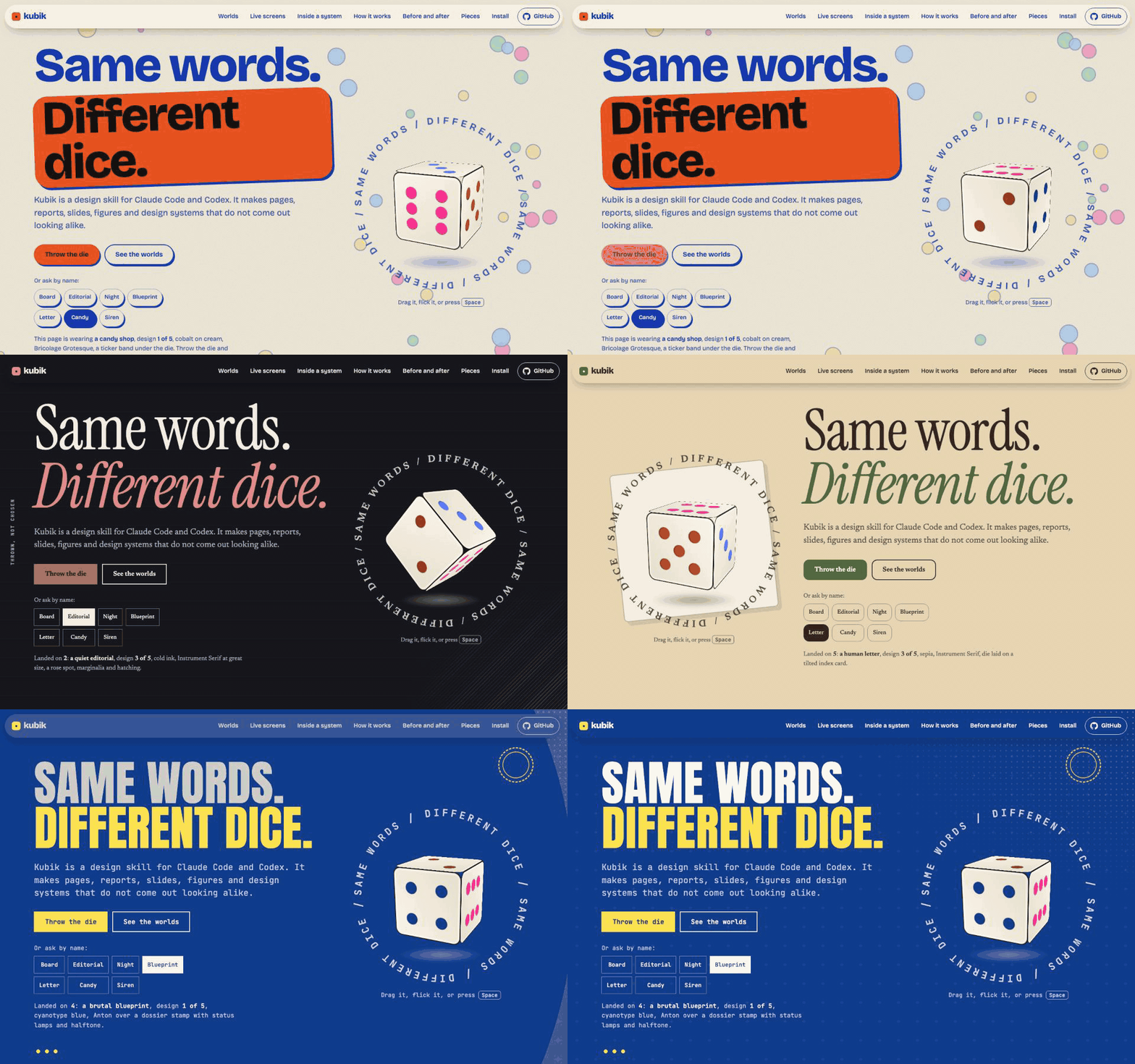
Open the landing page and throw the die.
Kubik designs interfaces two ways now.
A whole interface. Ask for a tracker, a console, a booking flow or a settings page and kubik builds the design system and the screens together: roles, states, the kit, and for screens that show work over time, the live views from 1.2.
One component inside a system you already have. Hand kubik a finished design system in any
form (a tokens.css, a Tailwind config, JSON tokens, a DESIGN.md, a screenshot) and name one
component: a 24-hour timeline, a booking step, an orders table, a deploy view, a ticket queue.
Kubik first writes the system down as one system.map.json, then throws the dice for what the
system leaves open (composition, how the data is shown, how it is operated) and builds three to
five implementations, each only from that system's tokens. A value the system lacks is proposed
by name, with a reason. scripts/tokens-lint.mjs checks every variant and prints one line, for
example 220 values: 216 from the system, 4 proposed, 0 forbidden; a colour, a length, a duration
or a query width written by value fails, with the nearest token named.
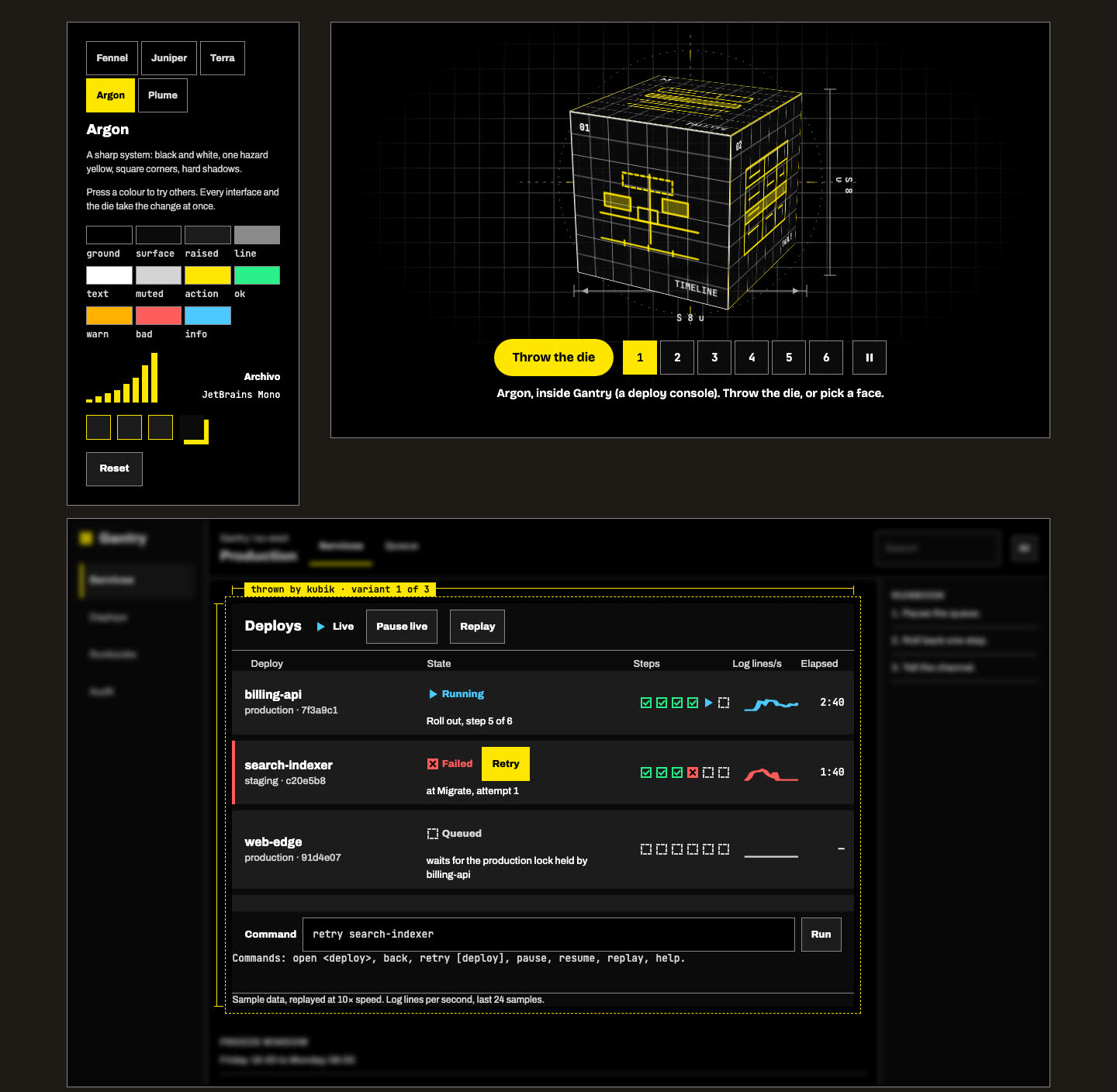
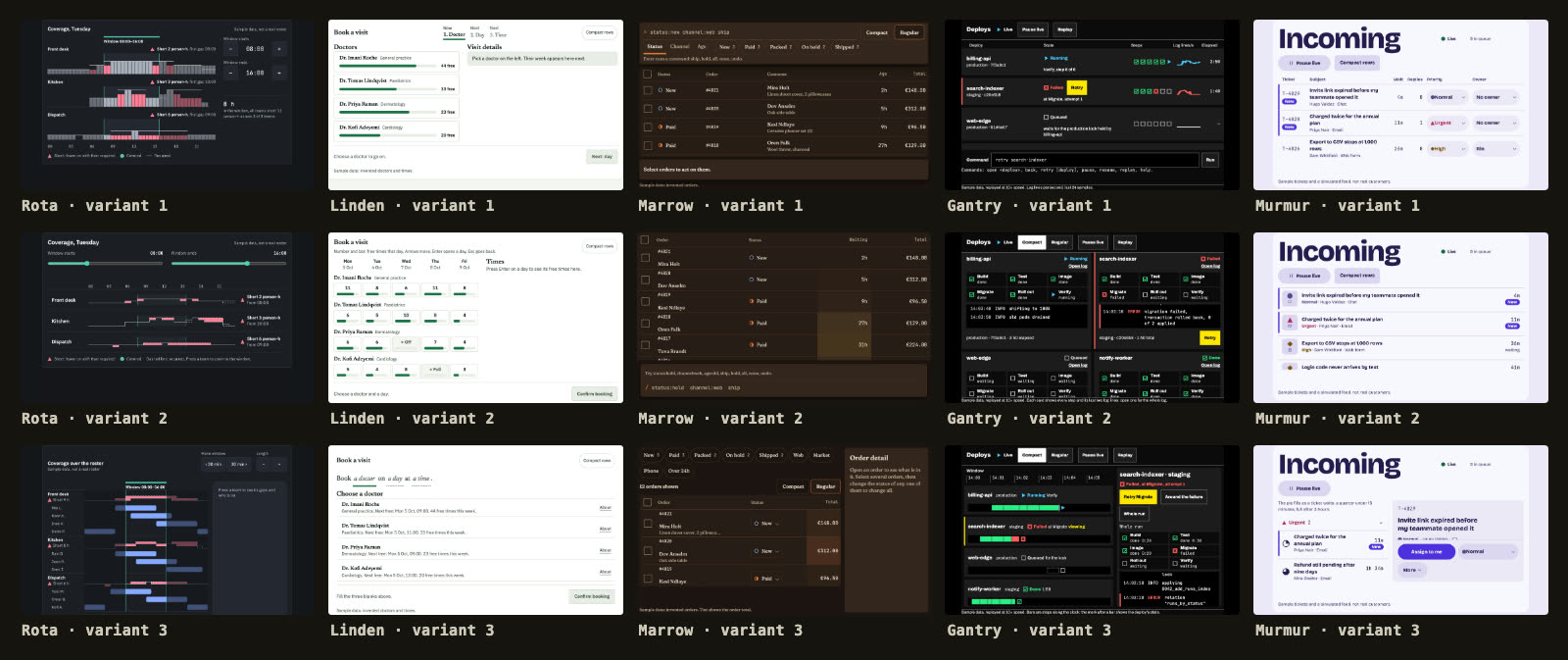
Fifteen components from five kubik runs, three per run, each run given one invented system and one component to build. Every variant came out of one throw of the dice and is shown as it came out; every tokens-lint line reads 0 forbidden. On the landing page the die throws them into their product screens.
Interfaces also keep still: a state change moves nothing, a select opens a list drawn in the
system with the full keyboard, and a new thing appears where it stands instead of sliding in.
With --press, the audit warns when a press moves the pressed element or its neighbours, replaces
it by a re-render, or drops keyboard focus.
Everything kubik runs is Node now: the dice, the hooks, the lints and the audit. Nothing needs bash, so the plugin works the same on Windows.
Ask kubik for a tracker, a console or a settings page and it now builds the screen for the person who operates it. Where work runs over time (runs, deployments, agents, queues), the screen gets a view shaped by time: an axis with a line for now, a feed where new items wait behind an "N new" chip while you read, a panel that opens an item beside the list, and ⌘K for every action. Five current characters join the seven older ones in the roll, and the skill names the look it steers away from: an opening row of boxed KPI tiles with an uppercase label over each.
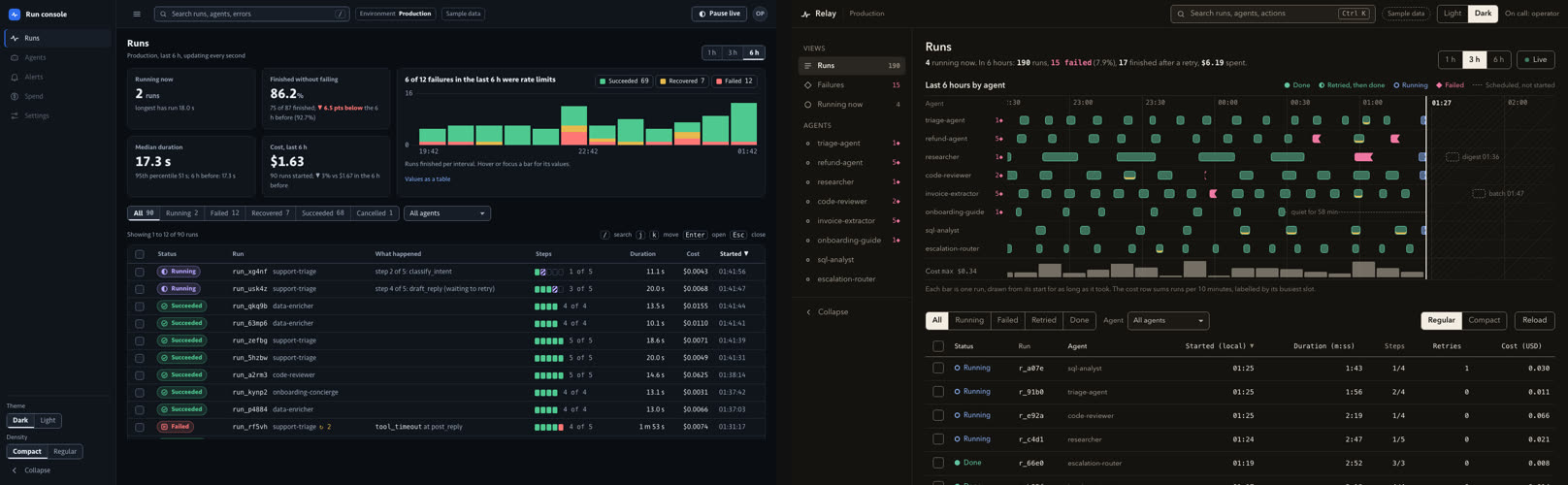
The same brief built twice: with kubik 1.0 (left) and with kubik 1.2 (right). In a blind test, five interfaces were each built three ways and scored out of 25 by a critic who did not know which was which. Kubik 1.2 came first on all five (114 in total), kubik 1.0 second (106), no kubik third (87). It was one build per cell, so the order holds and the size of the gap is a first reading.
Claude Code
/plugin marketplace add stakost/kubik
/plugin install kubik@kubik
Codex
codex plugin marketplace add stakost/kubik
then open /plugins and install kubik. Codex asks once whether to trust the plugin's hooks.
From a local copy, before or instead of the published repository, give either runtime the
path: /plugin marketplace add /path/to/kubik in Claude Code, codex plugin marketplace add /path/to/kubik in Codex.
Without the plugin machinery, on any runtime that reads a skills directory: link
skills/kubik into it (~/.claude/skills/kubik, or ~/.agents/skills/kubik). The hooks are not
installed this way.
The dice, the hooks and the lints need Node 16 or newer and no browser.
The audit and the deck photographer need Node 22 or newer and a Chromium-family browser: they look
for Chrome, Chromium, Edge, Brave and the browsers Playwright and Puppeteer keep in their caches,
on macOS, Linux and Windows, and on PATH; CHROME_PATH (or --chrome <path>) names one they did
not find. Without a browser they exit with code 3 and a sentence saying so, and the lint still
runs; the skill tells the agent to carry on and say in its note what was not checked. Nothing else
is needed: no shell, nothing installed from npm, and nothing ever installs anything to make a
check run.
Say what you want, as briefly or as fully as you like. What you say leans the dice; what you leave
out is read from the occasion (who reads it, where, what for) and only then rolled. Start with the
word kubik, or invoke the skill by its name the way your runtime does (/kubik:kubik in Claude
Code).
For a text with no page around it (a memo, a report body, a post, a letter, a summary, or a
draft that reads like a model wrote it), the second skill, kubik-words, writes or rewrites it
for the person who will read it: what to keep for that reader, and the habits that give a machine
away, in English and in Russian. The same file runs over every string of every piece kubik makes.
kubik: slides about the quarter
kubik: a report, quiet, like a newspaper, green
kubik: landing for the plugin, loud, dark, no purple
kubik: figures for the board, our brand blue, with a pie of the cost split
| You can name | Choices |
|---|---|
| the kind | a page, a report, slides, figures, a design system |
| the register | quiet (clean, flat, simple), balanced, loud |
| a page style | minimal, brutal, luxe, cinema |
| a world | a broadsheet, a Swiss memo, a night sky, a control room, and the rest of skills/kubik/menu.md |
| a reference | a link, a screenshot, "like that product": kubik takes its decisions, not its pixels |
| anything else | a colour or a brand, a typeface, the audience, what must not appear |
Ask "what can kubik do" and it shows the menu.
A project that holds a DESIGN.md is read first: what it decides is kept, and only what it
leaves free is rolled. Kubik writes that file itself when asked for a design system.
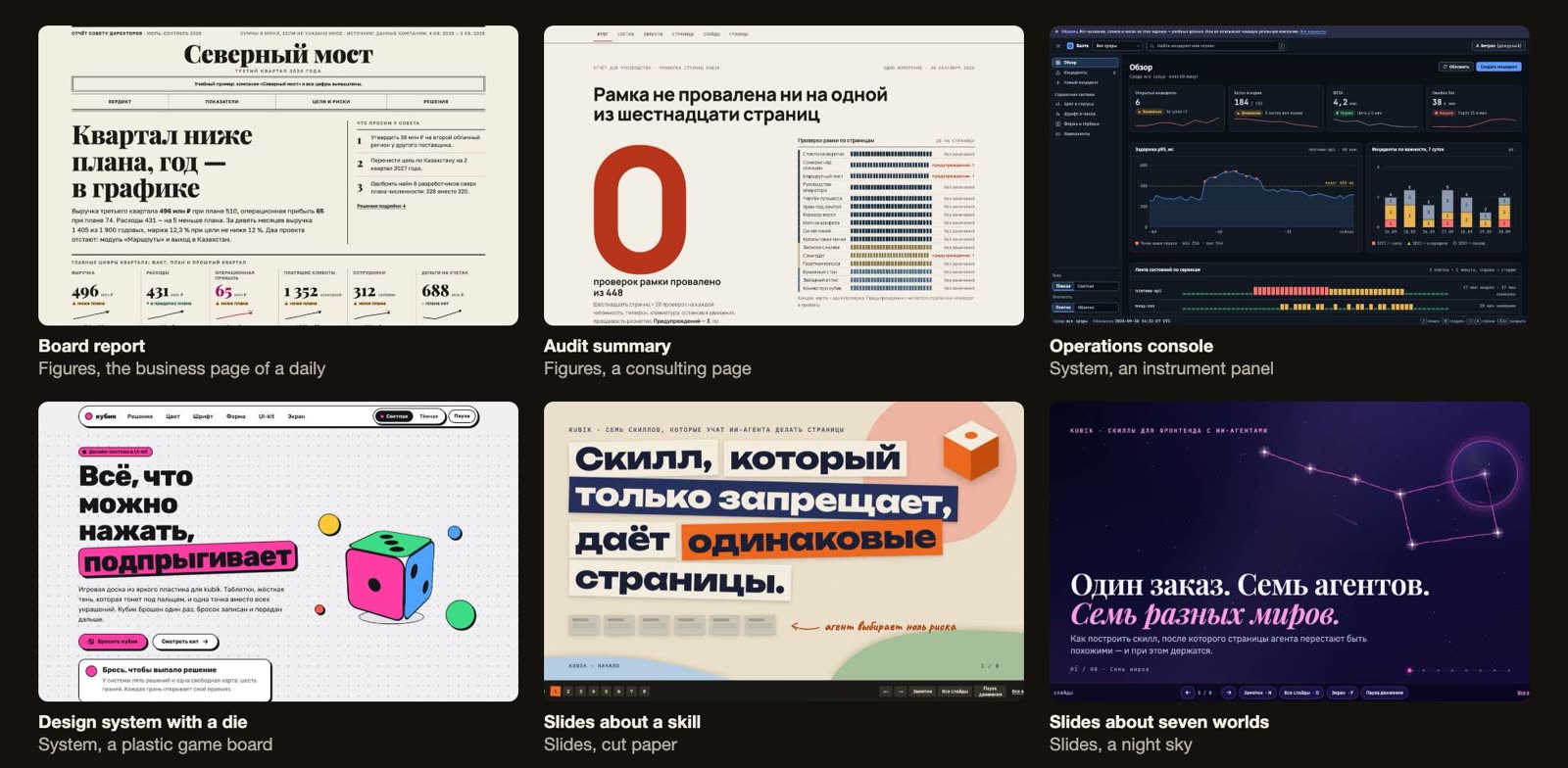
Six finished pieces, built with kubik on sample content. Two are figures, two are design systems, and two are slides. The text inside them is Russian.
The same goes for the words. Kubik runs its words rules over every string it puts on a page, and kubik-words rewrites any text on its own.
A model's default. In today's fast-paced digital landscape, great design is more crucial than ever. Kubik is a powerful, innovative design skill that seamlessly empowers developers to unlock stunning, cutting-edge interfaces. Ready to take your designs to the next level?
After kubik-words. Kubik is a skill for Claude Code and Codex that designs pages, reports, slides, figures and design systems. Tell it what you want to see, in any words. It throws dice for whatever you left open, draws one concept, and opens the result in a real browser before it hands it to you.
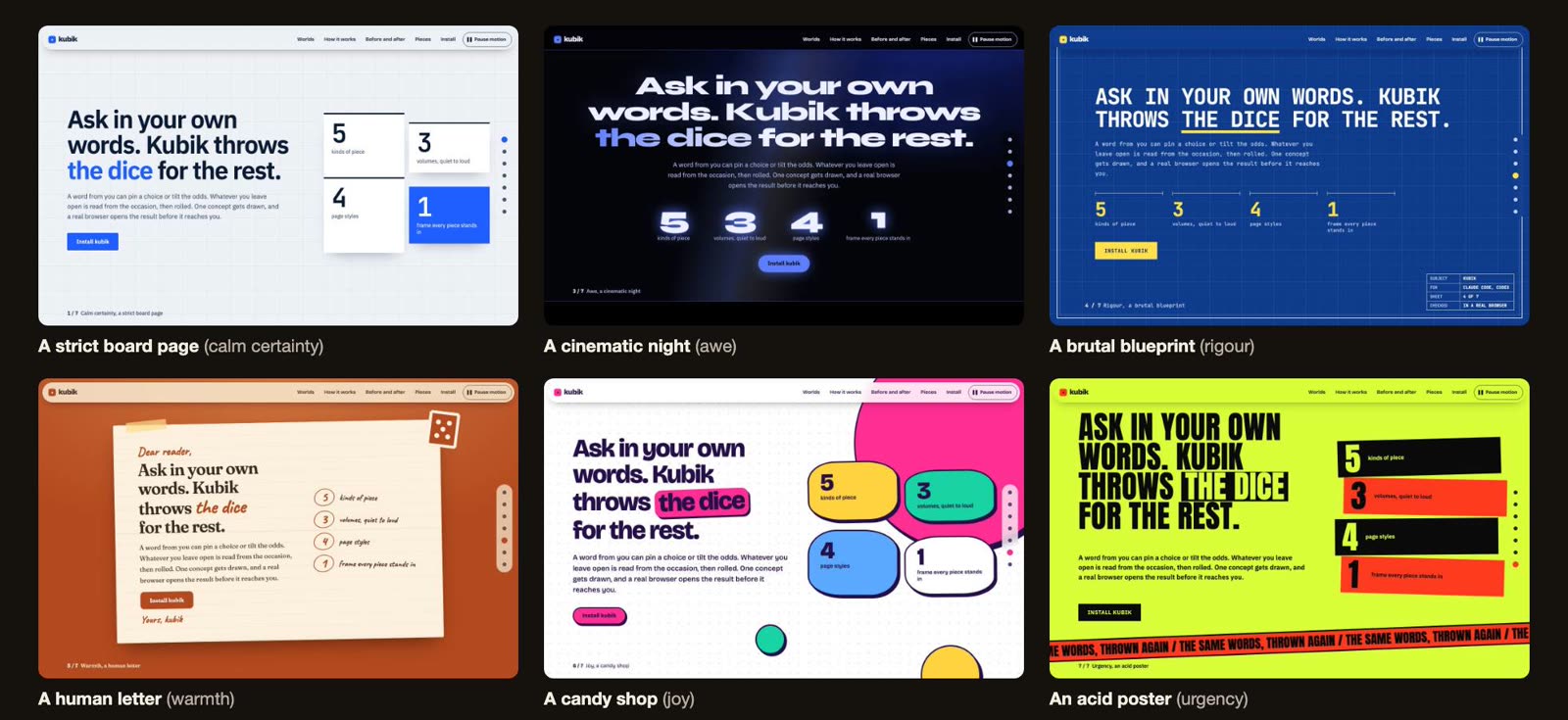
The same message, thrown into six worlds. Each is a different feeling and a different way of showing information; the words stay put.
- The frame (
frame.md) is what the reader needs: true content, text that can be read, a page that works on a phone and from a keyboard, controls that answer the touch, motion that can be stopped. It says nothing about how a piece should look. Its governing rule: repair the defect, keep the effect. - The method (
method.md) is how the work goes: listen, throw the dice, three concepts to choose from, one signature moment, a world with its own light and depth, the build, one more step past comfortable, and then the frame. - The shelves in each kind and style are examples to choose from, not a standard: worlds, typefaces, devices, charts, motion.
- The dice (
scripts/roll.mjs) pull a card from each shelf at random, so the work does not begin with the most likely answer. A wish settles a card or weights it (night sky*3). - The cheap look first (
scripts/lint.mjs) reads the file in a second, without a browser, and names what the audit would fail.scripts/deck-runtime.jsis the shared machine of a deck (keys, wheel, swipe, hash, builds, overview, notes, reading mode), copied into each deck so that nobody rewrites it wrong;scripts/page-runtime.jsis the per-element motion controls and the theme switch for any piece (the rule isframe.md§7). - The look before shipping (
scripts/page-audit.mjs) opens the piece in a browser at desktop and phone width, in dark mode and with reduced motion, walks it with the keyboard, and ends its output with two lists: FRAME (pass, fail, warn) and RICHNESS (how much atmosphere, graphics, motion and response the piece has). For slides,scripts/deck-shots.mjsphotographs every slide, measures its text, and tries the controls: arrow, wheel, button, swipe.
One skill, one description in the session's list. Its other files are read only when the work calls for them. Three hooks each add one short line and never load the skill themselves:
- at session start, and after a clear, a compaction or a resume: kubik exists, and when to load it;
- on a prompt that reads like design work, at most three times a session: load kubik, and pass it what the person said;
- when a subagent starts: the same, since a subagent does not see the session's skill list.
The same three hooks are wired for both runtimes. They were tested by feeding the script sample
events; in a live session only Claude Code's session hook format is known to work, from another
plugin that uses it. TESTING.md lists what to confirm on each runtime.
The prompt hook keeps its count of reminders in ${XDG_STATE_HOME:-~/.local/state}/kubik/, one
small file per session, swept after a day. It is the only thing the plugin writes outside its own
directory.
skills/kubik/
  SKILL.md         the entry: listen, find the kind, the style, the register
  method.md        how to work
  frame.md         what every piece owes its reader
  words.md         what the words on it say, and how, for the person who reads them
  quiet.md         the quiet register, for any kind
  menu.md          what can be asked for
  page.md          a landing page, with page/ for its companion files
  report.md        a report
  slides.md        a deck
  figures.md       a dashboard, a board pack
  system.md        a design system for working software: the record, the tokens, the specimen; and variants of one component inside a given system
  system/map.md    the one format any given system is turned into, before variants are made
  reference.md     how to borrow from a reference
  styles/          minimal, brutal, luxe, cinema
  page/            shelf, scroll, redesign, habits, libraries: a page's companion files
  scripts/         roll.mjs, lint.mjs, tokens-lint.mjs, page-audit.mjs, deck-shots.mjs, browser.mjs, page-runtime.js, deck-runtime.js, vendor/axe.min.js
skills/kubik-words/
  SKILL.md         the text skill: a router to skills/kubik/words.md
hooks/
  kubik-hook.mjs   one script, three modes: session, prompt, subagent
  hooks.json       the wiring for Claude Code
  hooks-codex.json the wiring for Codex
tests/
  run.mjs          the package's own checks: node tests/run.mjs
  fixtures/        small pages and token maps the checks run on
TESTING.md         what to test by hand on each runtime, and how to report it
AGENTS.md          rules for whoever edits this repository
Apache License 2.0, see LICENSE. Kubik may be used, changed and redistributed, in commercial and
corporate work included. Whoever redistributes it, or a work derived from it, keeps the NOTICE
file: the author's name and the link to this repository stay with every copy.
Pages, reports, decks and systems made with kubik are yours; the licence asks nothing of them.
skills/kubik/scripts/vendor/axe.min.js is axe-core by Deque Systems, distributed unmodified
under the Mozilla Public License 2.0; its notice is at the top of the file.