Function secret sharing (FSS) primitives including:
- 2-party distributed point function (DPF), based on Boyle et al. (CCS '16) or Half-Tree (EUROCRYPT '23).
- 2-party distributed comparison function (DCF), based on Boyle et al. (EUROCRYPT '21) or Grotto (CCS '23).
- 2-party verifiable distributed point function (VDPF), based on Castro & Polychroniadou (EUROCRYPT '22).
- 2-party verifiable distributed multi-point function (VDMPF), based on Castro & Polychroniadou (EUROCRYPT '22).
Features:
- First-class support for GPU (based on CUDA)
- Top-tier performance shown by benchmarks
- Well-commented and documented
- Header-only library, easy for integration
Multi-party computation (MPC) is a subfield of cryptography that aims to enable a group of parties (e.g., servers) to jointly compute a function over their inputs while keeping the inputs private.
Secret sharing is a method that distributes a secret among a group of parties, such that no individual party holds any information about the secret.
For example, a number
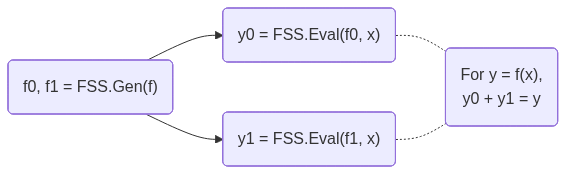
FSS is a scheme to secret-share a function into a group of function shares.
Each function share, called as a key, can be individually evaluated on a party.
The outputs of the keys are the shares of the original function output.
FSS consists of 2 methods: Gen for generating function shares as keys and Eval for evaluating a key to get an output share.
FSS's workflow is shown below:
DPF/DCF are FSS for point/comparison functions.
They are called out because 2-party DPF/DCF can have
- CMake >= 3.22
- CUDA toolkit >= 12.0 (for C++20 support). Tested on the latest CUDA toolkit.
- OpenSSL 3 (only required for CPU with AES-128 MMO PRG)
Clone the repository:
git clone https://github.com/myl7/fss.git
cd fss
Option A: Install via CMake and use find_package
cmake -B build -DBUILD_TESTING=OFF -DCMAKE_INSTALL_PREFIX=/path/to/install
cmake --build build
cmake --install build
Then in your project's CMakeLists.txt:
find_package(fss REQUIRED)
target_link_libraries(your_target fss::fss)
When configuring your project, point CMake to the install prefix:
cmake -B build -DCMAKE_PREFIX_PATH=/path/to/installOption B: Use as a subdirectory (header-only)
Without installing, you can define the target directly in your CMakeLists.txt, like the samples do:
add_library(fss INTERFACE)
target_include_directories(fss INTERFACE "/path/to/fss/include")
target_compile_features(fss INTERFACE cxx_std_20 cuda_std_20)
Then link it in your project:
target_link_libraries(your_target fss)This walks through using DPF and DCF on the CPU with AES-128 MMO PRG. This PRG requires OpenSSL.
-
Include the headers and set up type aliases:
#include <fss/dpf.cuh>
#include <fss/dcf.cuh>
#include <fss/group/bytes.cuh>
#include <fss/prg/aes128_mmo.cuh>

constexpr int kInBits = 8;  // Input domain: 2^8 = 256 values
using In = uint8_t;
using Group = fss::group::Bytes;

// DPF uses mul=2, DCF uses mul=4
using DpfPrg = fss::prg::Aes128Mmo<2>;
using DcfPrg = fss::prg::Aes128Mmo<4>;
using Dpf = fss::Dpf<kInBits, Group, DpfPrg, In>;
using Dcf = fss::Dcf<kInBits, Group, DcfPrg, In>;
-
Create the PRG with AES keys and instantiate DPF/DCF:
// DPF PRG needs 2 AES keys
unsigned char key0[16] = {1, 2, 3, 4, 5, 6, 7, 8, 9, 10, 11, 12, 13, 14, 15, 16};
unsigned char key1[16] = {16, 15, 14, 13, 12, 11, 10, 9, 8, 7, 6, 5, 4, 3, 2, 1};
const unsigned char *keys[2] = {key0, key1};
auto ctxs = DpfPrg::CreateCtxs(keys);

DpfPrg prg(ctxs);
Dpf dpf{prg};
-
Run
Gento generate correction words (keys) from secret inputs:In alpha = 42; // Secret point / threshold int4 beta = {7, 0, 0, 0}; // Secret payload (LSB of .w must be 0) // Random seeds for the two parties (LSB of .w must be 0) int4 seeds[2] = { {0x11111111, 0x22222222, 0x33333333, 0x44444440}, {0x55555555, 0x66666666, 0x77777777, static_cast<int>(0x88888880u)}, }; Dpf::Cw cws[kInBits + 1]; dpf.Gen(cws, seeds, alpha, beta);
-
Run
Evalon each party and reconstruct using the group:// Each party evaluates independently int4 y0 = dpf.Eval(false, seeds[0], cws, alpha); int4 y1 = dpf.Eval(true, seeds[1], cws, alpha); // Reconstruct via the group: convert to group elements, add, convert back // For Bytes group this is XOR; for Uint group this is arithmetic addition int4 sum = (Group::From(y0) + Group::From(y1)).Into(); // sum == beta at x == alpha, 0 otherwise
-
Free the AES contexts when done:
DpfPrg::FreeCtxs(ctxs);
DCF follows the same pattern — use DcfPrg (mul=4, needs 4 AES keys), Dcf, and Dcf::Cw. The reconstructed output equals beta when x < alpha and 0 otherwise.
Link with OpenSSL in your CMakeLists.txt:
find_package(OpenSSL REQUIRED)
target_link_libraries(your_target fss OpenSSL::Crypto)
See samples/dpf_dcf_cpu.cu for the complete working example.
This walks through using DPF and DCF on the GPU with ChaCha PRG.
-
Include the headers and set up type aliases:
#include <fss/dpf.cuh>
#include <fss/dcf.cuh>
#include <fss/group/bytes.cuh>
#include <fss/prg/chacha.cuh>

constexpr int kInBits = 8;
using In = uint8_t;
using Group = fss::group::Bytes;

// DPF uses mul=2, DCF uses mul=4
using DpfPrg = fss::prg::ChaCha<2>;
using DcfPrg = fss::prg::ChaCha<4>;
using Dpf = fss::Dpf<kInBits, Group, DpfPrg, In>;
using Dcf = fss::Dcf<kInBits, Group, DcfPrg, In>;
-
Set up a nonce in constant memory and create the PRG in a kernel:
__constant__ int kNonce[2] = {0x12345678, 0x9abcdef0};

__global__ void GenKernel(Dpf::Cw *cws, const int4 *seeds, const In *alphas, const int4 *betas) {
    int tid = blockIdx.x * blockDim.x + threadIdx.x;

    DpfPrg prg(kNonce);
    Dpf dpf{prg};

    int4 s[2] = {seeds[tid * 2], seeds[tid * 2 + 1]};
    dpf.Gen(cws + tid * (kInBits + 1), s, alphas[tid], betas[tid]);
}
-
Prepare host data, copy to device, and launch the
Genkernel:int4 *d_seeds = /* cudaMalloc + cudaMemcpy seeds to device */; In *d_alphas = /* cudaMalloc + cudaMemcpy alphas to device */; int4 *d_betas = /* cudaMalloc + cudaMemcpy betas to device */; Dpf::Cw *d_cws; cudaMalloc(&d_cws, sizeof(Dpf::Cw) * (kInBits + 1) * N); GenKernel<<<blocks, threads>>>(d_cws, d_seeds, d_alphas, d_betas);
-
Write and launch an
Evalkernel for each party, then copy results back:__global__ void EvalKernel(int4 *ys, bool party, const int4 *seeds, const Dpf::Cw *cws, const In *xs) { int tid = blockIdx.x * blockDim.x + threadIdx.x; DpfPrg prg(kNonce); Dpf dpf{prg}; ys[tid] = dpf.Eval(party, seeds[tid], cws + tid * (kInBits + 1), xs[tid]); } // Launch for party 0 and party 1, then copy d_ys back to host EvalKernel<<<blocks, threads>>>(d_ys, false, d_seeds0, d_cws, d_xs); EvalKernel<<<blocks, threads>>>(d_ys, true, d_seeds1, d_cws, d_xs);
-
Reconstruct on the host using the group, same as the CPU case:
int4 sum = (Group::From(h_y0s[i]) + Group::From(h_y1s[i])).Into();
DCF follows the same pattern — use DcfPrg (mul=4), Dcf, and Dcf::Cw.
See samples/dpf_dcf_gpu.cu for the complete working example.
samples/ holds a standalone program per scheme. They form their own CMake project:
cmake -B build/samples -S samples
cmake --build build/samples| Sample | Scheme | Shows |
|---|---|---|
dpf_dcf_cpu.cu |
DPF, DCF | Host Gen/Eval with AES-128 MMO PRG |
dpf_dcf_gpu.cu |
DPF, DCF | Gen/Eval inside CUDA kernels with ChaCha PRG |
half_tree_dpf_cpu.cu |
Half-Tree DPF | Gen/Eval/EvalAll with a mul=1 PRG and a separate hash key |
grotto_dcf_cpu.cu |
Grotto DCF | Gen/Preprocess/Eval over a parity segment tree, plus EvalAll |
vdpf_cpu.cu |
VDPF | Gen/Eval plus the Prove/Verify check |
vdmpf_cpu.cu |
VDMPF | Gen/BatchEval over cuckoo-hash packed points |
The CPU samples link OpenSSL, and EvalAll uses OpenMP when it is found.
The fss_crypto package exposes PyTorch wrappers for DPF and DCF. It is
published on PyPI as fss-crypto.
Install it with pip:
pip install fss-cryptoOr add it to a uv project:
uv add fss-cryptoThe package requires Python >= 3.13 and PyTorch >= 2.6. The first use of each
parameter set JIT-compiles a small CUDA extension with
torch.utils.cpp_extension.load, so the CUDA toolkit is required even when the
example below runs on CPU tensors. The aes128_mmo PRG also links OpenSSL at
JIT time. Compiled extensions are cached under ~/.cache/fss_crypto.
To develop against a checkout instead, install the dev extra and run the tests:
uv sync --extra dev
uv run pytest
import torch
import fss_crypto
dpf = fss_crypto.Dpf(in_bits=8, group="bytes", prg="chacha")
s0s = torch.tensor(
[
[0x11111111, 0x22222222, 0x33333333, 0x44444440],
[0x55555555, 0x66666666, 0x77777777, -0x77777780],
],
dtype=torch.int32,
)
beta = torch.tensor([7, 0, 0, 0], dtype=torch.int32)
cws = dpf.gen(s0s, alpha=42, beta=beta)
y0 = dpf.eval(party=0, s0=s0s[0], cws=cws, x=42)
y1 = dpf.eval(party=1, s0=s0s[1], cws=cws, x=42)
assert torch.bitwise_xor(y0, y1).equal(beta)gen and eval_all are CPU-only. eval can run on CUDA tensors for ChaCha
PRG when CUDA is available. The JIT path sets a default TORCH_CUDA_ARCH_LIST
on machines with no visible GPU so CPU tests can still compile the extension.
You may see warnings like "integer constant is so large that it is unsigned" during compilation. These cannot be easily suppressed but are harmless and can be safely ignored.
nvcc 12.8 fails to compile the stub file when fss::group::Uint<__uint128_t, ...> is used as a template argument to a __global__ kernel — it emits a 128-bit integer literal that g++ cannot parse. __device__ functions are not affected (no stub is generated for them).
Workaround: wrap the type in a plain aggregate struct that satisfies Groupable but has no __uint128_t non-type template parameter in its name. The struct must have no user-declared constructors to remain an aggregate. See third_party/fss/bench.cu for an example.
Microbenchmarks built on Google Benchmark, covering:
- Schemes: DPF, DCF, VDPF, Half-Tree DPF, and Grotto DCF.
- Operations:
Gen,Eval, hostEvalAll, VDPFProve, Grotto DCFPreprocessandPreprocessEvalAll, GPU point eval, and full-domain GPUEvalAll. - PRGs: AES-128 MMO over OpenSSL, AES-128 MMO over AES-NI intrinsics, software AES-128 MMO, and ChaCha. The CPU benchmarks cover all four. The GPU benchmarks cover ChaCha and software AES-128 MMO, the two that run on device.
- Output groups:
UintandBytes. - VDPF hashes: SHA-256 and BLAKE3.
- Input domain sizes: 2^20 everywhere, plus 2^14 and 2^17 for DPF
Eval.
Configure with BUILD_BENCH=ON and build the targets:
cmake -B build -DBUILD_BENCH=ON -DCMAKE_BUILD_TYPE=RelWithDebInfo
cmake --build build --target bench_cpu bench_gpu
Run all benchmarks:
./build/bench_cpu
./build/bench_gpu
Run a subset using --benchmark_filter (regex):
./build/bench_cpu --benchmark_filter=BM_DcfGen
./build/bench_cpu --benchmark_filter=BM_DpfEval_Uint_Aes/20
The Makefile has shortcuts for the same runs. make bench_cpu pins the run to
one core and switches that core to the performance governor, which needs
sudo. make bench_gpu pins the run to one GPU. Both write their log under
build/.
CPU_ID=0 make bench_cpu
GPU_ID=1 CUDA_ARCH=120 make bench_gpu
CUDA_ARCH is only needed when CMake cannot infer the architecture. Two more
targets support the sections below: make ptx_info rebuilds with
--ptxas-options=-v and collects the register usage into build/ptx_info.log,
and make profile_gpu records an Nsight Systems profile of one benchmark
selected by GPU_PROFILE_BENCH.
Run on Intel Xeon Platinum 8352V @ 2.10GHz (Ice Lake), single core, pinned with taskset -c 0. The host is shared and runs the schedutil cpufreq governor, so the effective single-core clock varies with host load (observed 0.8-3.5 GHz). Per-key rows run one op per iteration, so Avg per item equals Time and Items/s counts keys. EvalAll rows process 2^20 outputs per iteration, so their Items/s counts outputs and Avg per item is its reciprocal.
| Benchmark | PRG | Time | Avg per item | Items/s |
|---|---|---|---|---|
| BM_DpfEval_Uint_Aes/20 | Aes128Mmo<2> |
1078 ns | 1078 ns | 927.6k/s |
| BM_DpfEval_Uint_Aes/14 | Aes128Mmo<2> |
751 ns | 751 ns | 1.332M/s |
| BM_DpfEval_Uint_Aes/17 | Aes128Mmo<2> |
931 ns | 931 ns | 1.074M/s |
| BM_DpfGen_Uint_Aes/20 | Aes128Mmo<2> |
2272 ns | 2272 ns | 440.1k/s |
| BM_DpfEval_Bytes_Aes/20 | Aes128Mmo<2> |
1076 ns | 1076 ns | 929.4k/s |
| BM_DpfEvalAll_Uint_Aes/20 | Aes128Mmo<2> |
78.7 ms | 74.9 ns | 13.34M/s |
| BM_DpfEval_Uint_ChaCha/20 | ChaCha<2> |
3823 ns | 3823 ns | 261.6k/s |
| BM_DpfEval_Uint_AesSoft/20 | Aes128Soft<2> |
4094 ns | 4094 ns | 244.3k/s |
| BM_DpfEval_Uint_AesRaw/20 | Aes128MmoRaw<2> |
333 ns | 333 ns | 3.003M/s |
| BM_DpfEval_Bytes_AesRaw/20 | Aes128MmoRaw<2> |
345 ns | 345 ns | 2.899M/s |
| BM_DpfGen_Uint_AesRaw/20 | Aes128MmoRaw<2> |
463 ns | 463 ns | 2.160M/s |
| BM_DpfGen_Bytes_AesRaw/20 | Aes128MmoRaw<2> |
428 ns | 428 ns | 2.336M/s |
| BM_DcfEval_Uint_AesRaw/20 | Aes128MmoRaw<4> |
343 ns | 343 ns | 2.915M/s |
| BM_DcfEval_Bytes_AesRaw/20 | Aes128MmoRaw<4> |
412 ns | 412 ns | 2.427M/s |
| BM_DcfGen_Uint_AesRaw/20 | Aes128MmoRaw<4> |
645 ns | 645 ns | 1.550M/s |
| BM_DcfGen_Bytes_AesRaw/20 | Aes128MmoRaw<4> |
698 ns | 698 ns | 1.433M/s |
| BM_DcfEval_Uint_Aes/20 | Aes128Mmo<4> |
1481 ns | 1481 ns | 675.2k/s |
| BM_DcfGen_Uint_Aes/20 | Aes128Mmo<4> |
3264 ns | 3264 ns | 306.4k/s |
| BM_DcfEval_Bytes_Aes/20 | Aes128Mmo<4> |
1772 ns | 1772 ns | 564.3k/s |
| BM_DcfEvalAll_Uint_Aes/20 | Aes128Mmo<4> |
97.8 ms | 93.2 ns | 10.73M/s |
| BM_DcfEvalAll_Bytes_Aes/20 | Aes128Mmo<4> |
98.6 ms | 93.9 ns | 10.64M/s |
| BM_VdpfEval_Uint_Aes_Sha256/20 | Aes128Mmo<2> |
2499 ns | 2499 ns | 400.2k/s |
| BM_VdpfGen_Uint_Aes_Sha256/20 | Aes128Mmo<2> |
4146 ns | 4146 ns | 241.2k/s |
| BM_VdpfEval_Uint_Aes_Blake3/20 | Aes128Mmo<2> |
1437 ns | 1437 ns | 695.9k/s |
| BM_VdpfProve_Uint_ChaCha_Blake3/20 | ChaCha<2> |
181 ns | 181 ns | 5.525M/s |
| BM_VdpfEvalAll_Uint_Aes_Sha256/20 | Aes128Mmo<2> |
2138 ms | 2037 ns | 491k/s |
| BM_HalfTreeDpfEval_Uint_Aes/20 | Aes128Mmo<1> |
1017 ns | 1017 ns | 983.3k/s |
| BM_HalfTreeDpfGen_Uint_Aes/20 | Aes128Mmo<1> |
2236 ns | 2236 ns | 447.2k/s |
| BM_HalfTreeDpfEvalAll_Uint_Aes/20 | Aes128Mmo<1> |
86.9 ms | 82.8 ns | 12.08M/s |
| BM_GrottoDcfEval_Aes/20 | Aes128Mmo<2> |
17.0 ns | 17.0 ns | 58.82M/s |
| BM_GrottoDcfPreprocess_Aes/20 | Aes128Mmo<2> |
57.7 ms | — | — |
| BM_GrottoDcfPreprocessEvalAll_Aes/20 | Aes128Mmo<2> |
119.9 ms | 114.2 ns | 8.758M/s |
Run on NVIDIA RTX PRO 5000 (72GB VRAM, Blackwell, sm_120), CUDA 13.2, driver 595.71.05. The host is shared: the GPU boost clock varies with host state (observed 180-2355 MHz). Each iteration runs 1M (2^20) keys in parallel. Time is the whole batch. Avg per item is the reciprocal of Items/s: per key for Eval/Gen/point-eval rows, per output for EvalAll rows (2^40 outputs per iteration).
| Benchmark | PRG | Time | Avg per item | Items/s |
|---|---|---|---|---|
| BM_DpfEval_Uint_ChaCha/20 | ChaCha<2> |
1398.8 µs | 1.334 ns | 749.6M/s |
| BM_DpfEval_Uint_ChaCha/14 | ChaCha<2> |
765.7 µs | 0.730 ns | 1.369G/s |
| BM_DpfEval_Uint_ChaCha/17 | ChaCha<2> |
956.8 µs | 0.912 ns | 1.096G/s |
| BM_DpfGen_Uint_ChaCha/20 | ChaCha<2> |
1965.4 µs | 1.874 ns | 533.5M/s |
| BM_DpfEval_Bytes_ChaCha/20 | ChaCha<2> |
1398.9 µs | 1.334 ns | 749.6M/s |
| BM_DpfEval_Uint_AesSoft/20 | Aes128Soft<2> |
3087.5 µs | 2.944 ns | 339.6M/s |
| BM_DcfEval_Uint_ChaCha/20 | ChaCha<4> |
1421.2 µs | 1.355 ns | 737.8M/s |
| BM_DcfGen_Uint_ChaCha/20 | ChaCha<4> |
1969.1 µs | 1.878 ns | 532.5M/s |
| BM_VdpfEval_Uint_ChaCha_Blake3/20 | ChaCha<2> |
1241.3 µs | 1.184 ns | 844.7M/s |
| BM_VdpfGen_Uint_ChaCha_Blake3/20 | ChaCha<2> |
2132.2 µs | 2.033 ns | 491.8M/s |
| BM_HalfTreeDpfEval_Uint_ChaCha/20 | ChaCha<1> |
1001.7 µs | 0.955 ns | 1.047G/s |
| BM_HalfTreeDpfGen_Uint_ChaCha/20 | ChaCha<1> |
1961.5 µs | 1.871 ns | 534.6M/s |
| BM_DpfEvalAllGpu_Uint_ChaCha/20 | ChaCha<2> |
71.3 s | 64.8 ps | 15.43G/s |
| BM_HalfTreeDpfEvalAllGpu_Uint_ChaCha/20 | ChaCha<1> |
90.9 s | 82.7 ps | 12.09G/s |
| BM_DpfEvalPointGpu_Uint_ChaCha/20 | ChaCha<2> |
1024.5 µs | 0.977 ns | 1.024G/s |
| BM_DcfEvalPointGpu_Uint_ChaCha/20 | ChaCha<4> |
1120.6 µs | 1.069 ns | 935.7M/s |
| BM_HalfTreeDpfEvalPointGpu_Uint_ChaCha/20 | ChaCha<1> |
1000.9 µs | 0.955 ns | 1.048G/s |
| BM_VdpfEvalPointGpu_Uint_ChaCha_Blake3/20 | ChaCha<2> |
1109.2 µs | 1.058 ns | 945.3M/s |
GPU kernel register usage (compiled for sm_120, --ptxas-options=-v):
| Kernel | Group | PRG | Registers | Stack | Smem |
|---|---|---|---|---|---|
| DpfEval | Uint | ChaCha<2> |
39 | ||
| DpfEval | Bytes | ChaCha<2> |
40 | ||
| DpfGen | Uint | ChaCha<2> |
43 | ||
| DpfGen | Bytes | ChaCha<2> |
48 | ||
| DpfEval | Uint | Aes128Soft<2> |
80 | 624B | 2304B |
| DpfGen | Uint | Aes128Soft<2> |
80 | 624B | 2304B |
| HalfTreeDpfEval | Uint | ChaCha<1> |
40 | ||
| HalfTreeDpfGen | Uint | ChaCha<1> |
46 | ||
| VdpfEval | Uint | ChaCha<2> |
40 | ||
| VdpfGen | Uint | ChaCha<2> |
79 | ||
| DcfEval | Uint | ChaCha<4> |
42 | ||
| DcfGen | Uint | ChaCha<4> |
50 | ||
| DpfEvalAll | Uint | ChaCha<2> |
55 | 5120B | |
| HalfTreeDpfEvalAll | Uint | ChaCha<1> |
55 | 5120B | |
| DpfEvalPoint | Uint | ChaCha<2> |
39 | ||
| DcfEvalPoint | Uint | ChaCha<4> |
46 | ||
| VdpfEvalPoint | Uint | ChaCha<2> |
40 | ||
| HalfTreeDpfEvalPoint | Uint | ChaCha<1> |
38 |
The PRG drives most of the difference. Software AES-128 MMO costs about twice the registers of ChaCha for the same scheme and group, and it is the only backend here that spills to stack and holds a T-table in shared memory. The mul parameter is part of the PRG type because it sets how many 16B blocks one Gen call produces. The EvalAll kernels use shared memory for per-block staging. Every kernel other than the two software-AES ones has zero spills.
Generate a CPU flamegraph with perf and FlameGraph:
perf record -g ./build/bench_cpu --benchmark_filter=BM_DpfEval_Uint_Aes/20
perf script | /path/to/FlameGraph/stackcollapse-perf.pl | /path/to/FlameGraph/flamegraph.pl > build/flamegraph.svg
make flamegraph runs the same steps, taking the FlameGraph checkout from
FLAMEGRAPH_DIR (default ../FlameGraph) and the benchmark from
FLAMEGRAPH_BENCH:
FLAMEGRAPH_DIR=/path/to/FlameGraph FLAMEGRAPH_BENCH=BM_DcfGen_Uint_Aes/20 make flamegraphOpen build/flamegraph.svg in a browser. The graph is interactive: click a frame to zoom in.
Apache License, Version 2.0
Copyright (C) 2026 Yulong Ming i@myl7.org