Quickstart | Status | Requirements | Download | Usage | Building | How It's Developed | Components and License
DOSKUTSU is a faithful port of Cave Story (Doukutsu Monogatari) to MS-DOS 6.22 on retro Pentium-class hardware. It plays Daisuke "Pixel" Amaya's 2004 freeware classic on real 1990s-era PCs via SDL3's DOS backend, DJGPP, and CWSDPMI.
The name is a portmanteau of DOS and Doukutsu Monogatari (Cave Story's original Japanese title).
DOSKUTSU exists for preservation and the engineering challenge of running Cave Story on a 1990s MS-DOS PC.
This project was 100% built agentically using Claude Code.
 |
 |
| Title Screen | First Lab Room |
 |
 |
| First Cave | SETUP.EXE |
captures from DOSBox-X running DOSKUTSU.EXE and SETUP.EXE
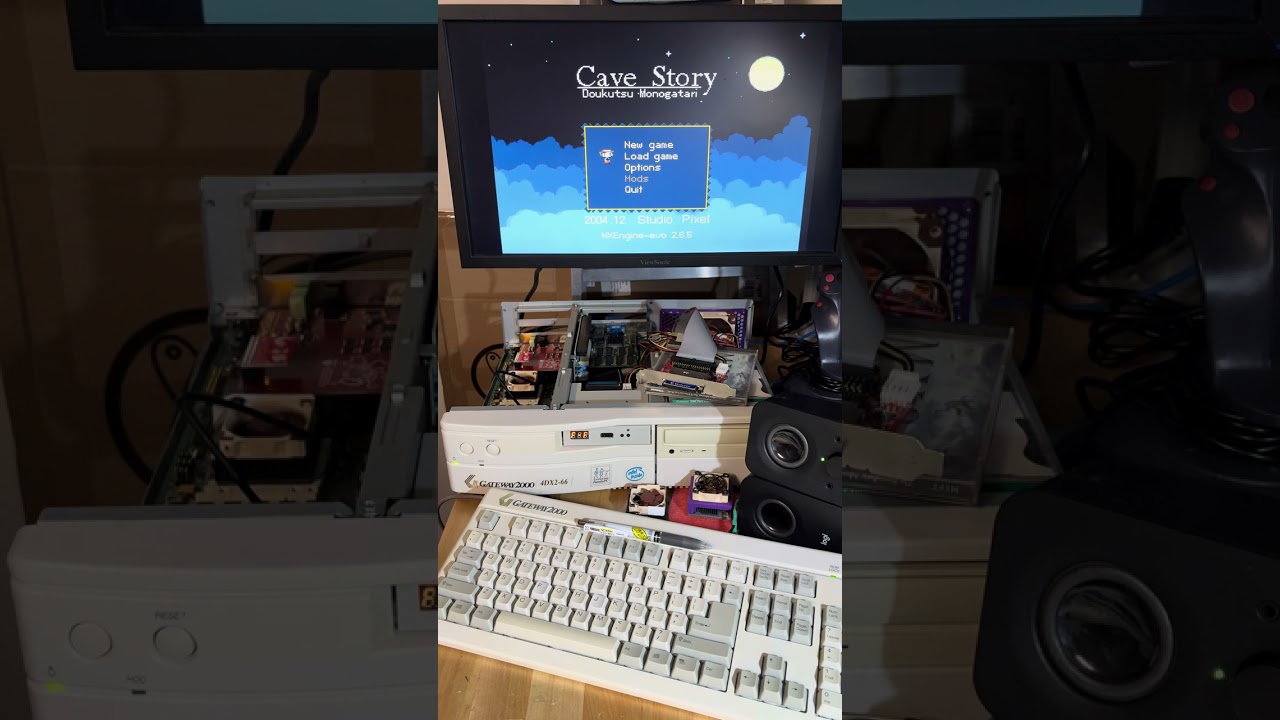
DOSKUTSU running on Gateway 2000 reference hardware
- Get the binaries. Build from source or download the latest
doskutsu-<version>.ziprelease and unzip it. - Add game data. DOSKUTSU ships no Cave Story content. See ASSETS.md for details.
- Copy the folder containing binaries and assets to a DOS system, or mount it in DOSBox-X.
- Configure sound. Run
SETUP.EXEto auto-detect sound cards or manually configure. - Play. Run
DOSKUTSU.EXEfrom the game folder.
See Download, Game Assets, Building, Usage, Configuration for details.
Features
- DOSKUTSU plays the full game, start to finish
- Sound Blaster, AdLib, OPL3 FM, WaveBlaster, General MIDI, Gravis UltraSound, and PicoGUS sound support
- Original Organya soundtrack or MIDI music with selectable arrangements (see docs/SOUND.md)
- Gameport joystick/gamepad support and input remapping
- DOS-era like
SETUP.EXEconfiguration utility - Up to ~33fps (depending on CPU and bus bandwidth)
- TAS support (see docs/TAS.md)
Frame rate depends on CPU, video card, and audio backend. Figures below are real-hardware measurements from an identical 102-second replay:
| CPU | Frame rate | Best configuration |
|---|---|---|
| Pentium OverDrive 83 | ~33 fps | AdLib + S3 ViRGE |
| Am5x86-133 | ~33 fps | AdLib + S3 ViRGE |
| 486DX2-66 | ~25 fps | AdLib + S3 ViRGE |
| 486DX2-50 | ~19 fps | AdLib + S3 ViRGE, choppy |
docs/BENCHMARKS.md is the full report: 157 cells across two measurement rounds, four CPUs, three video cards, and three sound cards, with charts, method, and raw logs.
Cave Story runs at 50 fps natively; on this hardware it renders at up to ~33 fps, but Fixed-Timestep mode keeps game logic advancing at the correct 50 Hz regardless of render rate.
See the changelog for development and progress details.
Recommended
- CPU: Pentium 75 MHz or faster
- RAM: 32 MB
- Video: VESA 1.2+ with 320x240 support
- Sound: Sound Blaster 16 or compatible; AdLib/OPL2-only and Gravis UltraSound (or PicoGUS) cards also supported
- OS: MS-DOS 6.22 or compatible
- Disk: 10 MB free
Minimum
- CPU: 486DX2-66 with FPU
- RAM: 16 MB
- Video: VESA 1.2+
- Sound: Sound Blaster 16 or compatible; AdLib/OPL2-only and Gravis UltraSound (or PicoGUS) cards also supported
- OS: MS-DOS 6.22 or compatible
- Disk: 10 MB free
Cave Story's engine ties game logic to the render rate, so at 30 fps it also runs at ~60% speed. Fixed-Timestep mode decouples the two: logic advances on a fixed 50 Hz clock regardless of frame rate, so the game plays at its intended speed even with fewer frames drawn. Motion is less smooth; speed is correct.
On by default; set SDL_HINT_DOS_FIXED_TIMESTEP=0 for the legacy frame-coupled loop.
Music plays through either Cave Story's original Organya synthesizer or MIDI. Organya is more faithful but costs significant CPU; MIDI runs on a hardware synthesizer, off the CPU, and is the recommended default. Supported hardware:
- Sound Blaster OPL3 FM -- the default; works on any Sound Blaster; sound effects on the SB DAC
- WaveBlaster / DreamBlaster -- wavetable daughterboard on the SB16 WaveBlaster header
- AdLib / OPL2 -- music on a card with no Sound Blaster (music only; no sound effects)
- Gravis UltraSound (or PicoGUS) -- GF1 wavetable music and sound effects; no Sound Blaster needed
- Organya -- Pixel's original tracker synth, in software (higher CPU cost)
MIDI backends offer a choice of music sets: an org2mid conversion of the original score (default), the WiiWare arrangement, or a custom drop-in set. Configure everything in SETUP.EXE; see docs/SOUND.md for sound configuration and docs/CONFIG.md for every setting and environment variable.
See Releases for pre-built binaries, or build from source (see Building).
Latest release: doskutsu-1.7.0.zip (v1.7.0)
Each bundle (doskutsu-<version>.zip) contains DOSKUTSU.EXE, SETUP.EXE, the CWSDPMI.EXE DPMI host, license texts, and NXEngine-evo's GPLv3 engine data. The engine is the program; game data is user-supplied, like a Doom source port shipping without an IWAD.
DOSKUTSU ships no Cave Story game data and plays nothing on its own. Users supply their own copy of the 2004 EN freeware assets, extracted from the canonical Doukutsu.exe.
docs/ASSETS.md is the canonical, complete procedure -- follow it start to finish; it covers fetching the freeware bundle, extracting the full data tree (maps, sprites, music, SFX), and the expected directory layout. The two scripts below automate only the Pixtone-SFX slice of that workflow; running them alone does not produce a playable DATA\ tree:
scripts/fetch-cs-pxt.pyis the one-shot orchestrator: fetches the 2004 EN freeware bundle from cavestory.one (SHA-256-pinned), extractsDoukutsu.exeto a tempdir, runs the Pixtone extractor, and cleans up. The archive doesn't persist after it runs.scripts/extract-pxt.pyis the canonical extractor, transcribed from NXEngine-evo'sextract/extractpxt.cpp. It reads file offsets inDoukutsu.exeand emits ASCII Pixtone parameter files.
Same posture as the broader Cave Story port community (NXEngine-evo, doukutsu-rs): engine code is open source, game data is user-supplied freeware.
DOSKUTSU.EXE, the CWSDPMI host, and the Cave Story data all live together in one directory:
C:\DOSKUTSU\
  DOSKUTSU.EXE     the game
  SETUP.EXE        hardware / sound configurator (run once before first play)
  SETUP.BAT        launcher for SETUP.EXE (clears stale audio settings first)
  CWSDPMI.EXE      the DPMI host - must sit beside DOSKUTSU.EXE
  DOSKUTSU.CFG     written by SETUP.EXE (optional; the game runs without it)
  DATA\            Cave Story assets, user-extracted (see Game Assets)
See Quickstart to get binaries/assets and set up the game directory.
The DOS machine needs a standard DJGPP boot environment: HIMEM.SYS loaded, NOEMS, a SB16-compatible BLASTER variable, and a VESA 1.2+ video BIOS (a software VESA driver works as a fallback).
Run SETUP.EXE once to configure sound (Configuration), then
run the game:
C:\DOSKUTSU> SETUP          (once, to configure)
C:\DOSKUTSU> DOSKUTSU       (play)
The title screen appears within a few seconds. Controls follow NXEngine-evo's defaults:
| Key | Action |
|---|---|
| Arrow keys | Move / navigate menus |
| Z | Jump / confirm |
| X | Fire / cancel |
| A / S | Cycle weapons |
| Q | Inventory |
| W | Map |
| Escape | Pause menu |
| F11 | Toggle fullscreen (no-op on DOS; always fullscreen) |
Use SETUP.EXE to map keys and configure joystick support.
Use SETUP.EXE to configure DOSKUTSU -- sound, input and other settings:
C:\DOSKUTSU> SETUP
SETUP detects hardware, recommends settings, and configures sound,
performance, and input. It can play a sound effect and the Title theme to
confirm audio works, then writes DOSKUTSU.CFG, which the game reads
at startup. See docs/SETUP.md for the full reference and
docs/SOUND.md for sound configuration.
Or skip SETUP and use DOS environment variables (SET in
AUTOEXEC.BAT or at the prompt). Precedence: environment variable >
DOSKUTSU.CFG > built-in default. See docs/CONFIG.md for
every option.
Building needs a Linux (or WSL) host with:
- the DJGPP cross-compiler -- the one prerequisite that isn't a package install (~30 min one-time build)
cmake,git,make,gcc,python3,unzip,zipdosbox-x-- runs the automated build-verification smoke tests
docs/BUILDING.md covers distro install commands, the DJGPP install, each build stage, DOSBox-X testing, and common errors.
Once DJGPP is installed -- the one-command path:
git clone https://github.com/ecliptik/doskutsu.git   # or ssh: git@github.com:ecliptik/doskutsu.git
cd doskutsu
./scripts/bootstrap.sh          # verify prereqs, fetch upstreams, apply patches, build
Or run stages individually:
./scripts/setup-symlinks.sh     # one-time: link tools/djgpp (only if using the ~/emulators hub)
./scripts/fetch-sources.sh      # clone the upstream repos at pinned SHAs
./scripts/apply-patches.sh      # apply DOS-port patches
make                            # orchestrate all four build stages
make smoke-fast                 # headless DOSBox-X smoke (fast config)
make setup                      # build SETUP.EXE (the configurator)
make setup-test                 # host-side SETUP unit tests
make dist bundles the game, CWSDPMI.EXE, and live-audio SETUP.EXE into a ready-to-deploy archive.
DOSKUTSU is developed agentically with Claude Code.
- Claude Code authors the patches across the SDL3 DOS backend, NXEngine-evo, the build system, scripts, and docs, landing as
patches/<vendor>/NNNN-*.patchfiles in this repository. - Human developers drive testing and iteration: TAS replays, real-hardware playthroughs, bug reports, and deciding what to fix next.
- Workspace-local patches only. Nothing is contributed upstream to libsdl-org/SDL, libsdl-org/SDL_mixer, libsdl-org/SDL_image, or nxengine/nxengine-evo.
DOSKUTSU's own source -- the build system, scripts, and documentation -- is MIT-licensed (LICENSE). The shipped DOSKUTSU.EXE is GPLv3: it statically links NXEngine-evo (GPLv3), which governs the combined binary. Patches under patches/ are derivative works of their upstreams and carry those licenses: GPLv3 for the NXEngine-evo patches, zlib for the SDL3 patches. Redistributed bundles include the GPLv3 license text and a pointer back to this repository.
Each component below is listed with its purpose, license, and whether it links into DOSKUTSU.EXE:
| Component | Purpose | License | In DOSKUTSU.EXE |
|---|---|---|---|
| DOSKUTSU port source (this repo) | Build system, patches, scripts, docs | MIT | n/a - source, not the binary |
| NXEngine-evo | The C++11 re-implementation of the Cave Story engine | GPLv3 | Yes - governs the binary |
| SDL3 | Platform layer; its DOS backend is what makes the port possible | zlib | Yes |
| SDL3_mixer | Audio mixing | zlib | Yes |
| SDL3_image | Image loading | zlib | Yes |
| DJGPP libc | 32-bit DOS C runtime, by DJ Delorie | free to use unmodified + GCC Runtime Library Exception for linked libgcc code |
Yes - neither imposes GPL on the result |
| CWSDPMI | DPMI host, by Charles W. Sandmann | freeware, redistributable | No - ships alongside as a separate program |
| Cave Story game data | Maps, sprites, music, and SFX, by Daisuke Amaya (2004) | freeware, 2004 terms | User extracted, not redistributed |
Built with the DJGPP toolchain (installed via build-djgpp by Andrew Wu), tested with DOSBox-X and real hardware.
Full attribution detail: THIRD-PARTY.md.